Candlemas

As I write this a storm is brewing...
...however, it felt like a warm spring day when I walked up the stairs to work this morning. The temperature will swing from its current 37 degrees down to minus 10 Saturday night. The skies will range from today's clear haint porch blue (a reference to a superstition - more on that later) to cloudy and overcast, to rain, to snow, and ice all in the next four days. We will soon have our second nor'easter in as many weeks.
This morning a furry rodent saw his shadow and scientifically forecast six more weeks of winter.
Naturally, I thought of Samuel Lancaster Gerry's 1855 painting The Snow Line, Mount Washington, New Hampshire in the collection of the North Carolina Museum of Art. (FMI and to use their nice online zoom feature see this link here).
You can divide the painting in half to watch the coming storm.
On the right you can see gray and pink clouds and patches of ultramarine and baby blue sky. Below that you can see a man standing near his dog holding a staff. Presumably they are herding the cows that follow a line towards the water. Silhouetted on the ridge to the right is the last straggling cow and a man on horseback who brings up the rear of the herd.
The left side of the painting shows the dark storm clouds coming in, the frosted branches of the trees and the billowing, wind-whipped, puffs of snow.
In the middle ground are the stark profiles of rocky ledges and beyond that in the distance the summit of Mount Washington, the tallest mountain peak in New England.
Below you can see the fascinating phenomenon of rime ice on the summit. These feathery fronds of ice actually form into the wind which approaches from the left in the photo.

With facilities like the observatory we have come a long way in weather forecasting. Winter on Washington has been a subject of interest for over 150 years, since the first over winter expedition of 1870-1871.
In fact these frost feathers (rime ice) were featured an illustration, description from the book that documented to expedition (facing p. 286). You can read it online here or see it for yourself in the Conway Public Library's Henney History Room here.


FMI see our previous blog here.


One member of the party was a photographer and he created a series of stereoviews from the expedition. FMI see our previous blog here.
While rare, there are a number of other winter related White Mountain paintings. You can see more of them at this link here.
While the focus of these paintings is on the overall beauty of the landscape, they often capture little details showing activities of the period.
Can you see the horse logging operation?

and oxen below...

...driving the livestock...

However, it was not all work. There was fun such as ice skating...

Maxfield Parrish was able to capture the essence of a winter twilight.

Winslow Homer's dusky sleighing scene below is almost an abstract painting.

We have several paintings on display in the Conway Public Library's History Hall.
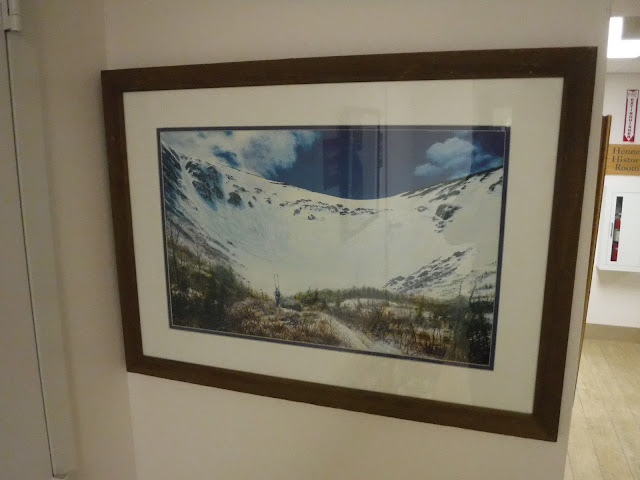

Here are some of the routes skied in the ravine.

Winslow Homer was adept at capturing evocative slices of life in his illustrations. The period from about 1300 to 1850 was known at "the little ice age" and you can see that in this picture.

In a future blog we will look at ways in which they kept themselves warm during the winter, what they ate, and how (besides a groundhog) they forecast and prepared for the weather.
For more information on this and other local history subjects contact us at the Conway Public Library's Henney History Room.


Comments
Post a Comment